logo
Startseite

Blog über New Fluorescence Tech Enhances Industrial Cooling Efficiency

Bescheinigung
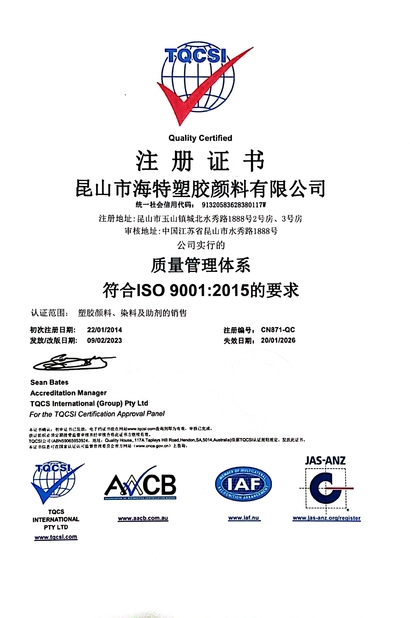
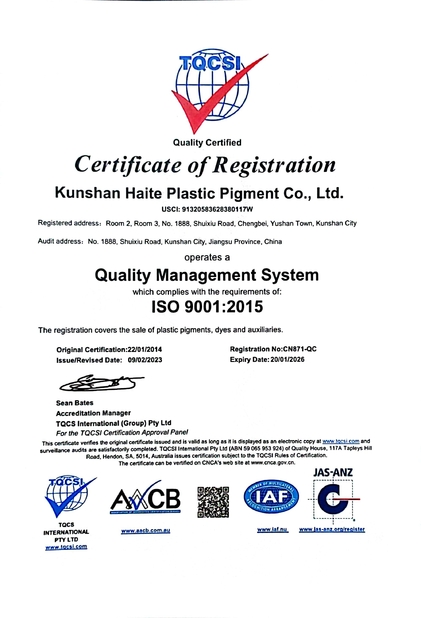
CHINA Kunshan Haite Plastic Pigment Co.,Ltd zertifizierungen
Kunden-Berichte
Wir prüfen die gelbe Probe und überprüfen seine Stabilität, und sie fällt aus, besser zu sein zu viel. Es ist für unsere Leuchtmarkertinte passend. Für diese Leuchtstofftintenfärbung erwägen wir, eine Reihe zu kaufen.

—— Hossein

Wir benutzen Leuchtstoffindikator PTSA als Indikator in den Wassersystemen zusammen mit unseren Wasserbehandlungschemikalien, um Wasserbilanzänderungen zu überwachen. Diese Probe wird von unserem Techniker genehmigt.

—— Park

Ich sendete ein iquiry und empfange bald Antwort. Dann sprachen wir durch WhatsApp-Telefon angenehm. Auftrag ist auf Verfahren.

—— Jose

Wir werden Leuchtmarker herstellen und 5 Farben erfordern, für den Leuchtmarkerstift zu färben. Nach Kommunikation telefonisch und Beispielzustimmung haben wir eine spezifische Anforderung über lösliches Grün 7.

—— Motiwala

Wegen der Sperre, begannen wir gerade, das letzte Reihenmaterial zu verbrauchen. Wir erlassen neuen Beschluss, sobald wir ihn benötigen. Im Juni ist die Hoffnung, die everthing ist, besser und kommt, wie formal.

—— Kim

Wir haben ein angenehmes Geschäft mit Kunshan Haite. Für den Ersterwerbkaufauftrag prüften wir die Proben, nachdem wir sie receving und sein Ergebnis war Maßnahme oben. Dieses Produkt kann als Wasserbehandlungsmittel in unserem on-line-Wolkensystem benutzt werden, holt uns mehr Leistungsfähigkeit so. Es ist, das zweite mal als wir von ihnen gekauft haben. Erwarten Sie, bei der Zeitdauer zusammenzuarbeiten.

—— Eram

Wir möchten lösliches Grün 7 zum Continuse-Tintenstrahldruckergebrauch in der Industrie für den Druck des Endes und die Herstellung des Datums verwenden. Es kann in der Tinte löslich sein.

—— Zain

Die Reihe löslichen Blaus, 36, die ich von Kunshan Haite kaufte, letzter Monat für uns wirklich verfügbar ist. Er beeinflußt nicht das ursprüngliche chemische Eigentum unseres Produktes. Er hat wirklich großes Hitze resisitance. Ich erwarte lösliche Färbungen des Auftrages anderer Farben als Nächstes für mehr Anforderungen von Kunden.

—— Tam

Ich bin ein Hersteller von antifreezer von Autos in Amerika. Ich benötige eine Art wasserlöslicher Farbstoff als Indikatormittel. Als ich lösliches Grün 7 von Haite sah. Ich trat mit dem Exporthändler in Verbindung, und schließlich erreichten wir eine Vereinbarung. Beispiel‚Leistung ist- für uns wirklich gut und verfügbar.

—— KEN

Ich bin online Chat Jetzt
Unternehmen Blog
New Fluorescence Tech Enhances Industrial Cooling Efficiency
Neueste Unternehmensnachrichten über New Fluorescence Tech Enhances Industrial Cooling Efficiency

Chapter 1: The "Invisible Pain Points" and Management Challenges of Industrial Water Treatment

In modern industrial production, recirculating cooling water systems are often described as the "circulatory system" of manufacturing facilities. However, cooling water treatment has long operated as a "black box" management system. Maintenance personnel face extensive pipe networks, complex heat exchangers, and constantly changing makeup water quality.

Traditional management models typically rely on either "manual sampling + offline analysis" or "flow-proportional chemical dosing." These approaches suffer from three critical flaws:

  • Latency: Offline analysis creates delays of several hours or even days between sampling and results, leaving systems vulnerable to sudden water quality fluctuations.
  • Blind Operation: Flow-proportional dosing assumes ideal system conditions, ignoring variables like blowdown fluctuations, evaporation losses, and natural chemical degradation.
  • Cost Inefficiency: To mitigate scaling risks, operators often over-dose chemicals, leading to inflated costs and potential environmental contamination from excess treatment chemicals.

Chapter 2: PTSA – The "Digital Eye" for Cooling Water Treatment

PTSA (1,3,6,8-pyrenetetrasulfonic acid tetrasodium salt) serves as a molecular-level tracer with one defining characteristic: complete chemical inertness. It participates in no chemical reactions, resists bacterial degradation, and remains unaffected by oxidizing biocides. Functioning as a a "digital probe" within the system, it accurately reflects chemical retention levels as it circulates with the water flow.

Technical Characteristics of PTSA:

  • Exceptional Sensitivity: PTSA can be detected at parts-per-billion (ppb) concentrations, enabling comprehensive system monitoring with minimal additive quantities.
  • Unique Fluorescence Signature: Under specific wavelength excitation, PTSA emits distinctive fluorescence that remains virtually interference-free from common water impurities, ensuring data integrity.

Chapter 3: From Experience-Based to Closed-Loop Control Systems

To maximize PTSA's potential requires implementing a complete closed-loop control architecture:

  1. Smart Sensing Layer: Solid-state fluorescence sensors with self-cleaning capabilities continuously monitor fluorescence intensity in water samples.
  2. Data Analysis Layer: Controllers convert fluorescence signals into precise chemical concentration values, comparing them against predefined target concentration curves.
  3. Execution Control Layer: When concentrations fall below thresholds, controllers automatically activate chemical feed pumps, switching to maintenance mode when optimal levels are achieved. This "real-time response" approach achieves dosing accuracy exceeding 95%.

Chapter 4: Implementation Considerations and Practical Challenges

Despite PTSA's technological maturity, industrial applications require attention to several critical factors:

  • Biocide Interference Mitigation: Certain quaternary ammonium biocides exhibit fluorescence quenching effects. During their application, systems should switch to "time-lock mode," resuming fluorescence monitoring only after complete dispersion.
  • Turbidity and Color Compensation: In high-turbidity systems, suspended solids scatter excitation light. Instruments must incorporate "dual-wavelength compensation" technology to subtract background interference.
  • Storage and Preparation Protocols: PTSA requires light-protected storage. Manufacturing processes must maintain strict temperature controls to prevent hydrolysis in alkaline conditions, ensuring tracer purity.

Chapter 5: Industry Trends – The Path Toward Smart Water Management

With global carbon neutrality initiatives advancing, industrial water conservation has become a critical ESG metric. PTSA technology represents more than cost reduction—it enables "demand-based dosing" as a sustainable manufacturing practice. Future integration with IoT platforms will facilitate cloud-based data analysis, offering comprehensive lifecycle optimization for water treatment systems.

Conclusion: In an industrial environment rife with variables, PTSA introduces measurable certainty to cooling water treatment. By transforming complex chemical management into quantifiable data streams, it liberates maintenance teams from routine testing burdens, redirecting focus toward system optimization. This advancement represents not merely technological progress, but a fundamental shift in industrial water treatment philosophy.

Kneipen-Zeit : 2026-10-08 00:00:00 >> Blog list
Kontaktdaten
Kunshan Haite Plastic Pigment Co.,Ltd

Ansprechpartner: Ms. Chai

Telefon: 18001549185

Faxen: 86-0512-5779-6655

Senden Sie Ihre Anfrage direkt an uns (0 / 3000)